
Blog
Are Essential Oil Diffusers Safe for Pets? A UK Guide for Dog and Cat Owners

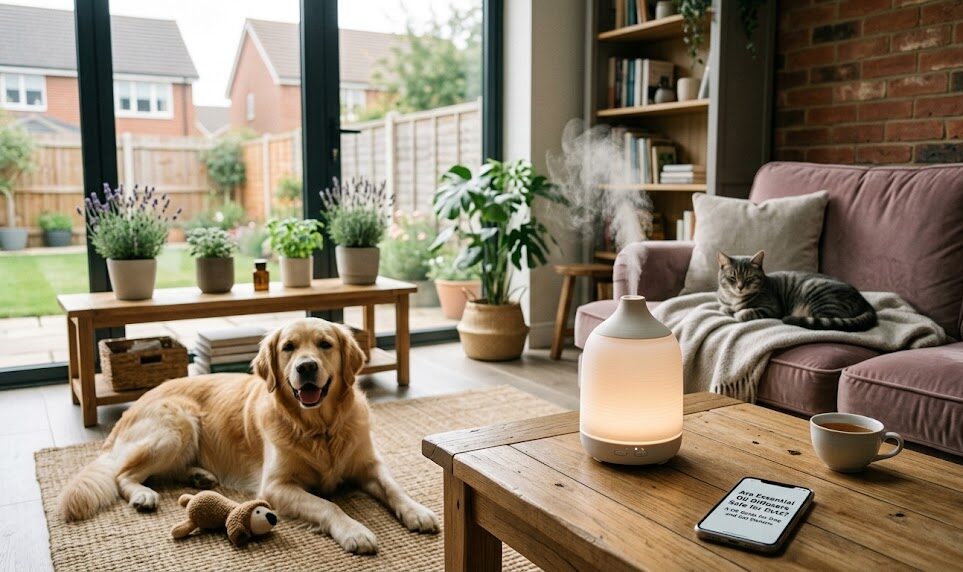
Yes — essential oil diffusers can be safe for pets when used correctly. The key conditions are: choosing genuinely pet-safe oils, ensuring adequate room ventilation, allowing your animal a clear exit route, and placing the diffuser well out of their reach. However, the risks are real and species-specific. Cats and dogs possess olfactory systems far more sensitive than ours, making them uniquely vulnerable to aerosolised particles that humans tolerate with ease.
Why Your Pet’s Nose Changes Everything
The average human has roughly 5 million olfactory receptors. Your dog has up to 300 million. Your cat’s sense of smell is estimated to be 14 times more acute than a person’s. What registers to you as a pleasant background scent can be genuinely overwhelming — and in some cases, physiologically harmful — to the animals sharing your home.
When an ultrasonic diffuser disperses essential oils into the air, it creates a fine mist of aerosolised particles that your pet inhales directly into their respiratory tract. Unlike humans, who can step outside or open a window on instinct, pets in a closed room have no choice but to breathe whatever is in their environment. This biological reality is the foundation of every safe-use principle in this guide.
⚠️ The Danger List: Oils That Are Toxic to Cats and Dogs
Understanding essential oil sensitivity by species is critical. Never assume an oil safe for one animal is safe for another.
🐱 Oils Toxic to Cats
Cats lack a key liver enzyme — glucuronyl transferase — that metabolises many phenols and terpenes found in essential oils. This makes them significantly more vulnerable than dogs.
⚠️ WARNING: The following oils should never be diffused in a home with cats, even in diluted form or with ventilation.
- Tea Tree (Melaleuca) — Even small quantities can cause severe neurological symptoms, including tremors and collapse.
- Peppermint — Contains menthol and pulegone, both toxic to feline liver function.
- Eucalyptus — Can cause drooling, vomiting, and central nervous system depression.
- Cinnamon — A powerful mucous membrane irritant; diffused particles cause respiratory distress.
- Clove — High in eugenol, which is poorly metabolised by cats and toxic to the liver.
- Lemon, Lime, and Orange (Citrus oils) — Contain limonene and linalool, both classified as toxic to cats by the ASPCA and the UK’s Veterinary Poisons Information Service (VPIS).
- Thyme — Contains thymol; known to cause hepatotoxicity in cats.
- Oregano — A high-phenol oil particularly dangerous for feline systems.
- Wintergreen — Contains methyl salicylate; metabolises similarly to aspirin, which is fatally toxic to cats.
- Pine and Spruce — Alpha-pinene causes liver damage with prolonged exposure.
- Ylang Ylang — Linked to ataxia, hypothermia, and cardiac complications in cats.
🐶 Oils Toxic to Dogs
Dogs metabolise compounds somewhat better than cats, but they are by no means immune to essential oil toxicity.
⚠️ WARNING: The following oils pose significant risks to dogs and should be avoided or used only under veterinary guidance.
- Pine — Can cause gastrointestinal upset and kidney stress with repeated exposure.
- Cinnamon — Causes oral and skin sensitisation; inhalation leads to coughing and breathing difficulties.
- Citrus oils — Can cause depression of the central nervous system, particularly in smaller breeds.
- Pennyroyal — Historically misused as a flea deterrent; highly hepatotoxic to dogs.
- Tea Tree — While dogs are somewhat more resilient than cats, concentrated diffusion still poses serious neurological risk.
- Juniper — Kidney irritant with prolonged or high-concentration exposure.
- Anise — Can cause gastrointestinal issues and has links to blood clotting disorders.
- Garlic and Onion — Occasionally found in blended oils; cause haemolytic anaemia in dogs.
- Clove — As with cats, eugenol is poorly tolerated and hepatotoxic.
✅ The Safe List: Pet-Friendly Oils (Used in Moderation)
No essential oil is entirely without risk when used irresponsibly. The following are generally considered lower-risk for most healthy adult dogs and cats when diffused briefly, in a well-ventilated space, with the pet free to leave the room.
Always introduce any new oil cautiously and observe your pet’s behaviour for 30 minutes before leaving them unattended.
| Oil | Notes |
| Lavender | Most widely vet-cited as tolerable. Use genuine Lavandula angustifolia, not lavandin. Brief diffusion only. |
| Frankincense | Generally well-tolerated by both dogs and cats; may have mild calming properties. Use sparingly. |
| Cedarwood (Atlas) | Often considered acceptable for dogs; use with extreme caution around cats. |
| Chamomile (Roman) | Mild and generally low-risk; avoid German chamomile (higher azulene content). |
| Ginger (diluted) | Occasionally used for dogs; minimal feline data — proceed with caution. |
| Cardamom | Low-toxicity profile; occasionally used in dog-focused blends. |
Important caveat: Even these “safer” oils must never be diffused continuously or in sealed rooms. The principle of moderation is non-negotiable.
Best Practices for Safe Diffuser Use Around Pets
Following these protocols is what separates responsible aromatherapy from a genuine welfare risk.
1. Ventilation Is Non-Negotiable
Diffuse only in rooms with an open window or active air flow. Aerosolised particles accumulate rapidly in enclosed spaces, and what begins as a mild scent can reach harmful concentrations within 30–60 minutes in a sealed room.
2. The Open Door Policy
Always ensure your pet has a clear, unobstructed exit. If your cat or dog chooses to leave the room, that is meaningful behavioural communication. Never force a pet to remain in a diffused space.
3. Diffuser Placement — Height and Distance Matter
- Place your diffuser on a high surface, well out of direct reach (accidental spillage of undiluted oil onto fur or skin causes chemical burns and systemic absorption).
- Keep it a minimum of 1.5–2 metres from your pet’s bed, feeding area, or favourite resting spot.
- Never place a diffuser in a room where your pet sleeps unsupervised overnight.
4. Limit Diffusion Time
30-minute sessions with breaks are considered a responsible maximum in a pet-occupied home. Continuous diffusion throughout the day creates cumulative exposure that is difficult to monitor and easy to underestimate.
5. Use Ultrasonic, Not Heat-Based Diffusers
Heat diffusers (candle burners, electric warmers) alter the chemical composition of oils during heating, potentially generating additional irritant compounds. BPA-free ultrasonic diffusers disperse oils at room temperature via ultrasonic vibration, preserving the original molecular structure of the oil and reducing this secondary risk. They remain the vet-preferred format for households with pets — though all safety protocols still apply.
6. Never Apply Diffused Oil Topically
This guide focuses on airborne diffusion, but a critical related point: never apply essential oils directly to your pet’s skin or coat, and never add them to their water. Topical toxicity is even more acute than inhalation toxicity.
Signs of Essential Oil Toxicity in Pets
Know these symptoms. If your pet shows any of them during or after diffuser use, remove them immediately to fresh air and contact your vet or the UK’s Animal Poison Line (01202 509000).
Cats — Watch For:
- Drooling or pawing at the mouth (immediate mucous membrane irritation)
- Watery eyes or squinting
- Lethargy or unusual unresponsiveness
- Vomiting
- Difficulty breathing or wheezing
- Muscle tremors or twitching (neurological involvement — treat as an emergency)
- Ataxia (wobbling or loss of coordination)
Dogs — Watch For:
- Persistent sneezing or coughing
- Nasal or eye discharge
- Excessive drooling
- Redness or burns around the nose or mouth
- Vomiting or diarrhoea
- Lethargy or depression
- Laboured or rapid breathing
- In severe cases: collapse or seizure activity
Do not wait to see if symptoms resolve on their own. Essential oil toxicity can progress rapidly, particularly in cats. Early veterinary intervention is significantly more effective than delayed treatment.
Frequently Asked Questions
Can I diffuse essential oils around kittens or puppies?
No — not safely. Young animals have immature liver function and underdeveloped detoxification pathways, making them even more vulnerable to essential oil toxicity than healthy adults. Puppies and kittens also spend significantly more time on the floor where dispersed oil particles settle and can be ingested during grooming. The VPIS recommends avoiding all essential oil diffusion in rooms regularly occupied by animals under 12 months of age.
How far should the diffuser be from my pet’s bed?
A minimum of 1.5 to 2 metres is the commonly cited safe distance, but this is a floor — not a target. The ideal is to diffuse in a separate room from where your pet sleeps. Oils diffused continuously in the same room as a pet bed create an inescapable exposure environment that accumulates over time, even with ventilation.
Is a waterless (nebulising) diffuser better or worse for pets?
Worse, generally. Nebulising diffusers disperse undiluted essential oil directly into the air, creating a significantly higher concentration of aerosolised particles than ultrasonic diffusers, which dilute oils in water before dispersal. For households with pets, ultrasonic diffusers using minimal amounts of oil are the lower-risk format. Nebulising diffusers are best restricted to pet-free rooms or spaces.
My cat just sniffed the diffuser — should I be worried?
A brief sniff is unlikely to cause harm. The concern arises with sustained, repeated, or concentrated inhalation. However, if your cat sniffed an active diffuser and then shows any of the symptoms listed above — particularly drooling, eye watering, or lethargy — contact your vet promptly. Cats are uniquely poor metabolisers, and erring on the side of caution is always appropriate.
Are reed diffusers safer than ultrasonic ones for pets?
Reed diffusers disperse oil passively and at very low concentrations, which makes them less acutely dangerous than active diffusers. However, they present a significant ingestion risk — undiluted oil sitting in an accessible jar is a serious hazard if knocked over or investigated by a curious cat. If using reed diffusers, ensure they are positioned completely out of reach and in well-ventilated spaces.
A Note on Our Diffusers
If you are looking for a safer way to enjoy aromatherapy in a pet-occupied home, our BPA-free ultrasonic diffusers are designed to disperse oils at room temperature without heat, making them a lower-risk option compared to candle burners or nebulisers. Because they use water to dilute oils before dispersal, concentrations remain lower and more controllable.
That said, the hardware is only one part of the equation. Safe diffuser use around pets is fundamentally about the oils you choose, the duration of diffusion, the ventilation you provide, and your pet’s freedom to leave the space. No diffuser — however well-designed — makes an unsafe oil safe or removes the need for the protocols outlined in this guide.
Always consult your vet before introducing aromatherapy into a home with animals who have pre-existing respiratory conditions, liver disease, or neurological sensitivities.
Summary: The Non-Negotiable Rules
- ✅ Choose genuinely pet-safe oils (lavender, frankincense, chamomile)
- ✅ Always allow your pet a clear exit from any diffused room
- ✅ Ventilate actively — open windows, not just doors
- ✅ Use ultrasonic diffusers over heat-based or nebulising alternatives
- ✅ Limit sessions to 30 minutes with adequate breaks
- ✅ Keep diffusers elevated and away from pet beds and feeding areas
- ❌ Never diffuse toxic oils around cats or dogs — even briefly
- ❌ Never diffuse around kittens, puppies, or immunocompromised animals
- ❌ Never apply essential oils directly to your pet’s skin, coat, or food
This guide is intended for general informational purposes. It does not constitute veterinary advice. If you have concerns about your pet’s health or their response to essential oils, always consult a registered veterinary surgeon. In the event of suspected poisoning, contact the Animal Poison Line on 01202 509000 (UK).
For More Details about our products please visit Aroma Diffusers Uk