
Blog
How Many Drops of Essential Oil Should You Put in a Diffuser? The Definitive UK Guide

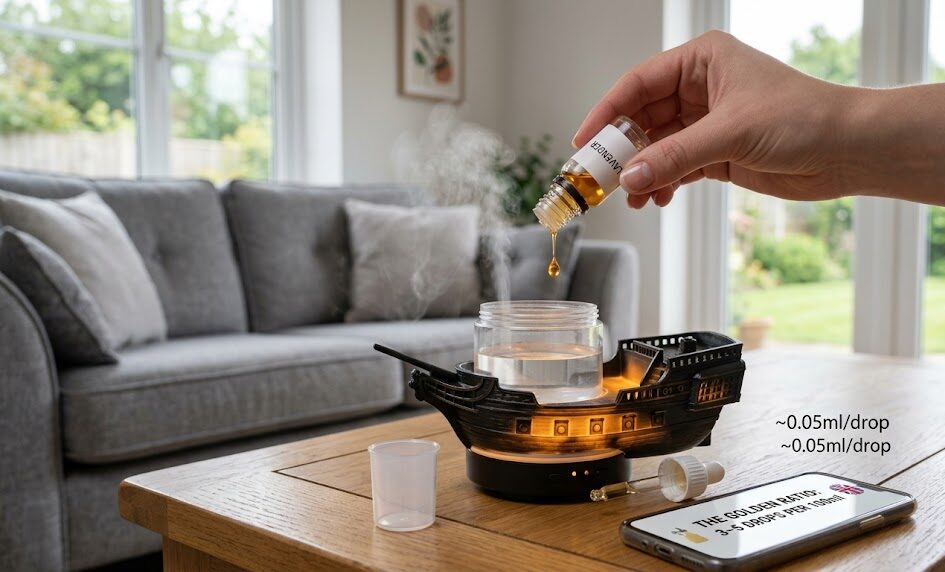
The short answer: Use 3–5 drops of essential oil per 100ml of water in your diffuser. For a standard 200ml diffuser, that means 6–10 drops. Adjust up or down based on room size, oil potency, and personal preference — but always start at the lower end.
The Golden Ratio: Essential Oil Drops by Tank Size
Getting the dilution ratio right is the single most important factor in effective, safe aromatherapy. Too few drops and you’ll barely notice the scent; too many and you risk olfactory fatigue, wasted oil, and potential damage to your diffuser’s ultrasonic disc.
The standard recommendation of 3–5 drops per 100ml is a widely accepted baseline across professional aromatherapy practice in the UK. Use the table below as your go-to reference:
| Tank Capacity | Minimum Drops | Recommended Drops | Maximum Drops |
| 100ml | 3 | 4–5 | 6 |
| 200ml | 6 | 8–10 | 12 |
| 300ml | 9 | 12–15 | 18 |
| 500ml | 15 | 20–25 | 30 |
First time using a diffuser? Start at the minimum and work upwards over several sessions. Our Beginner’s Guide to Setting Up Your Diffuser walks you through the full first-use process step by step.
Factors That Change the Count
The table above gives you a solid baseline, but several real-world variables will influence the optimal number of drops for your specific situation.
Room Size and Airflow
Room square footage is the most overlooked variable in home diffusing. A compact UK bathroom (typically 4–6 m²) will concentrate scent rapidly — stick firmly to the lower end of the range, or even drop to 2–3 drops per 100ml. By contrast, an open-plan kitchen-diner (often 25–40 m² in modern UK homes) may need you to nudge towards the upper limit of 5 drops per 100ml, and possibly run the diffuser on a longer cycle.
High ceilings, open windows, extractor fans, and air conditioning all disperse aromatic molecules more quickly, reducing scent throw. Conversely, a sealed bedroom with poor ventilation will amplify the concentration — less is always more in these spaces.
Oil Strength and Potency
Not all essential oils are created equal in terms of concentration. This is where many users go wrong.
Use fewer drops for high-potency oils:
- Peppermint – Intensely sharp; 2–3 drops per 100ml is ample
- Clove Bud – Powerful and potentially irritating at high concentrations
- Cinnamon Bark – Can cause respiratory discomfort in excess
- Eucalyptus – Effective at low concentrations; reduce to 2–3 drops if using with children present
- Tea Tree – Antibacterial even at low dilution ratios
You may use slightly more for lighter top notes:
- Sweet Orange, Lemon, or Grapefruit – Citrus oils evaporate quickly and have a lighter scent profile; 5–6 drops per 100ml is acceptable
- Bergamot – A little more volume helps with diffusion longevity
- Ylang Ylang – Paradoxically, this sweet floral becomes cloying at high concentrations; keep it to 3 drops maximum regardless
The dropper bottle is your best friend here. A standard essential oil dropper bottle dispenses approximately 0.05ml per drop, meaning precise, repeatable dosing every time — far more accurate than estimating from a pour.
Desired Effect: Subtle Background vs. Intensive Therapy
Are you diffusing for a gentle, ambient background scent while working from home, or seeking a more focused therapeutic session — say, Lavender for a pre-sleep ritual, or Eucalyptus for respiratory support during a cold?
- Subtle background ambience: Use 3–4 drops per 100ml and run the diffuser intermittently (30 minutes on, 30 minutes off)
- Moderate wellbeing support: Use 4–5 drops per 100ml on a standard cycle
- Intensive aromatherapy session: Up to 5–6 drops per 100ml, but limit the session to 30–60 minutes maximum and ensure the room is well ventilated
The Risks of Over-Diffusing
More oil does not mean better aromatherapy. This is one of the most common and costly mistakes home users make.
Olfactory Fatigue
Your olfactory receptors — the sensory cells responsible for detecting scent — can become temporarily desensitised after prolonged or intense exposure to aromatic compounds. This is known as olfactory fatigue (sometimes called nose blindness). Once it sets in, you may be tempted to add yet more drops because you “can’t smell it anymore.” Resist this urge entirely. The scent is still present; your receptors have simply adjusted. Adding more oil at this stage leads to gross over-concentration that others entering the room will immediately notice — and not pleasantly.
To avoid olfactory fatigue, follow the 30/30 rule: run your diffuser for 30 minutes, then give it a 30-minute rest. This approach also reduces your essential oil consumption considerably over time.
Damage to the Ultrasonic Disc
Most modern ultrasonic diffusers work by vibrating a small ceramic or metallic disc at high frequency, creating a fine mist. Excess essential oil — particularly undiluted or overly concentrated oil — leaves a sticky residue on this disc that degrades its performance over time. Over-oiling is one of the leading causes of diffuser malfunction and reduced mist output.
Regular cleaning is essential, especially if you diffuse daily. Our Diffuser Maintenance Guide covers how to remove oil residue safely, prevent build-up on the ultrasonic disc, and extend the life of your device significantly.
UK Household Context: What You Should Know
Typical UK Room Sizes
UK homes tend to be smaller than their North American counterparts, which has practical implications for diffusing. The average UK living room is approximately 17–20 m², and most bedrooms range from 9–14 m². These dimensions mean that even a mid-sized 300ml diffuser on a moderate setting will adequately scent an average bedroom within 10–15 minutes. Avoid running a 500ml diffuser at full concentration in a small UK room — it will quickly become overwhelming.
Soft vs. Hard Water and Scent Throw
The UK has notably varied water hardness by region. London, the South East, and East Anglia have particularly hard water (above 200mg/l calcium carbonate), whilst Scotland, Wales, and the North West have considerably softer water. This matters for diffusing.
Hard water contains a higher mineral content that can slightly interfere with the ultrasonic misting process, reduce mist output efficiency, and cause limescale build-up in the tank — which in turn affects how well essential oils are dispersed into the air. If you live in a hard water area, consider using filtered or bottled still water in your diffuser to improve scent throw and protect the device. You may find you can actually achieve equivalent results with slightly fewer drops when switching to filtered water, as the mist quality improves.
Soft water areas will generally experience cleaner mist output and more consistent scent diffusion with no adjustment needed to the standard drop ratios.
Have pets at home? Essential oils require extra caution around animals, particularly cats, dogs, and small birds. Always reduce your drop count by at least 50% and ensure the room is well ventilated when pets are present. See our Pet Safety Guide to Essential Oil Diffusing for full species-specific advice before diffusing near animals.
Frequently Asked Questions
Can I mix different essential oils in the same diffuser?
Yes — blending is one of the joys of home aromatherapy. However, the total drop count should still respect the 3–5 drops per 100ml guideline, not per oil. So for a 200ml diffuser, you might use 4 drops of Lavender and 4 drops of Cedarwood for a total of 8 drops — right in the middle of the recommended range. Be mindful of combining high-potency oils (e.g., Peppermint and Eucalyptus together) as the combined effect can be intense. Start with simple two-oil blends before experimenting further.
What if I can’t smell the oil after an hour?
This is almost certainly olfactory fatigue rather than an underdosing problem. Step outside for 10–15 minutes and return — if the scent is clearly present when you re-enter the room, your receptors had simply adjusted. If there is genuinely no scent after re-exposure, check that your diffuser is misting correctly, that the water level is adequate, and that your essential oil has not expired or evaporated (oils stored in warm, light-exposed conditions degrade rapidly). Do not add more drops as an immediate response to not smelling the oil.
Is more oil always better?
Definitively, no. Higher concentration does not improve therapeutic benefit proportionally and introduces real risks: respiratory irritation, headaches, nausea (particularly with potent oils like Eucalyptus or Peppermint at high concentrations), and the olfactory fatigue described above. From a practical standpoint, over-oiling also shortens diffuser lifespan and wastes expensive essential oils. The 3–5 drops per 100ml ratio has been developed precisely because it delivers effective aromatic concentration without excess.
The Right Diffuser Makes All the Difference
Even the most carefully measured drops of essential oil will underperform if your diffuser isn’t designed to handle them properly. Cheap plastic diffusers with poorly calibrated ultrasonic discs struggle to maintain even mist output at consistent oil concentrations.
Our Ship-model Ultrasonic Diffusers have been engineered with variable mist settings calibrated precisely around the 3–5 drops per 100ml standard, ensuring optimal dispersion whether you’re running a 100ml or 500ml tank. For those who prefer a more aesthetic option, our Ceramic Diffuser Collection combines beautiful design with passive and active diffusion, with ceramic interiors that resist oil residue build-up and work beautifully in typical UK room sizes.
Both ranges are designed to work with pure essential oils at the dilution ratios outlined in this guide — so you get the most from every drop.
Always consult a qualified aromatherapist before diffusing essential oils if you are pregnant, have a respiratory condition, or are diffusing around infants. This guide is for informational purposes and general home use.